
My initial view a couple of months ago…
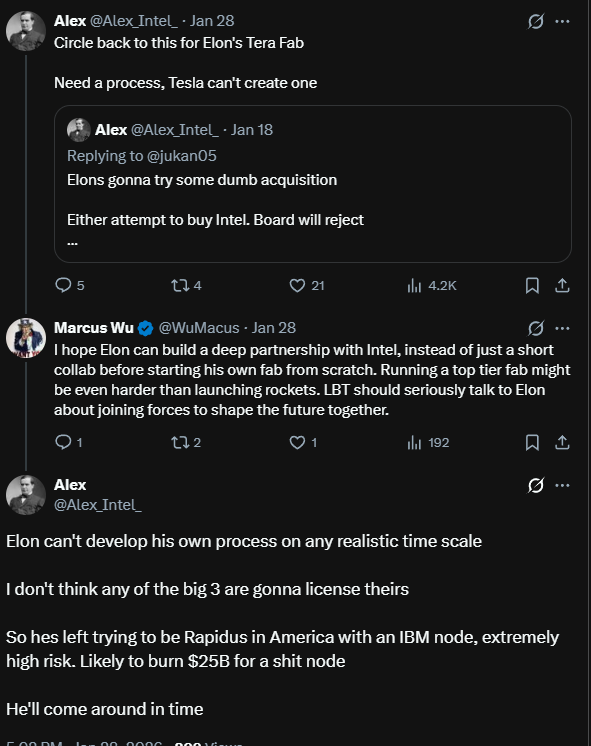
Then, as Elon really didn’t say anything, and I hardened my views on the unlikelihood of any Intel process license or a JV, I came to the conclusion that Elon would try a Rapidus approach, aka licensing an IBM node.
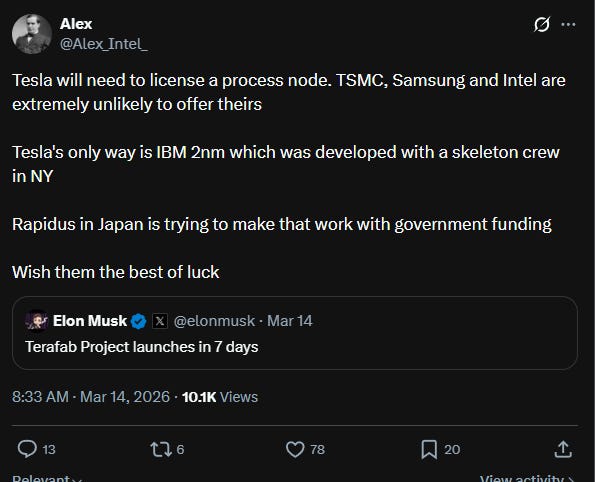
I could write a whole article on the absurdity of Rapidus and IBM, but here are a quick couple of reasons why it’s a horrible idea:
IBM sold its manufacturing to GlobalFoundries many years ago. They don’t have a full-scale R&D fab, nor do they actually have a real R&D team (sorry guys). IBM Research remained, and they continued with a skeleton process development crew in NY, using a shared university cleanroom to do their work. IBM kept them around to make some patent money until the Japanese government came to them and conceived of the idea of Rapidus.
Even when IBM had its manufacturing division and a full-scale R&D, it only produced a semi-successful 14nm node. It wasn’t amazing and was only used for IBM products. In fact, GlobalFoundries actually uses Samsung’s 14nm process… IBM has not had a node enter HVM since. If Samsung and Intel, with billions in R&D each year (Intel also poached IBM’s team) and full-scale R&D fabs, are barely getting there (Intel is on a healthy path now, Samsung is still having issues), Rapidus is doomed to fail. I suspect there will be major hurdles in yield and performance as they approach HVM, given IBM's 2nm has densities that match TSMC 2nm.
So what was announced?
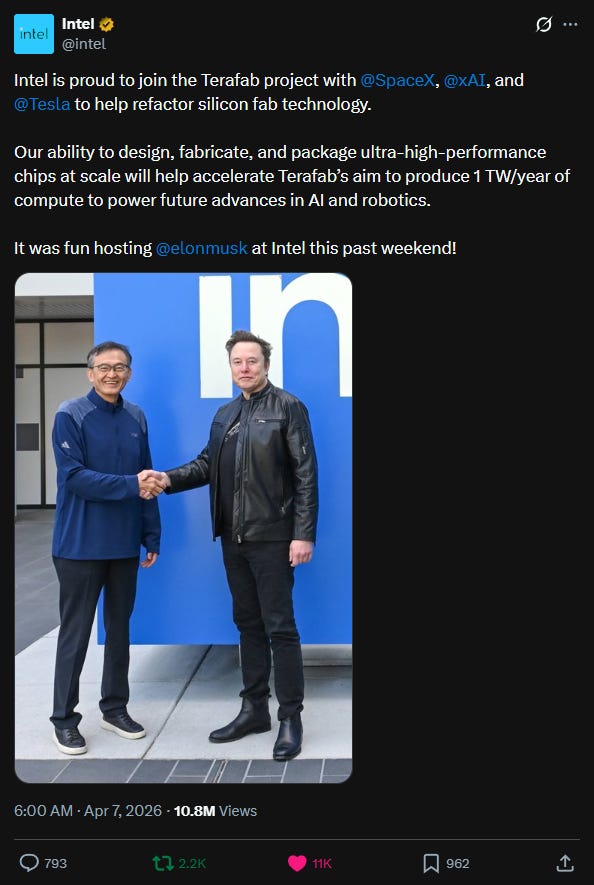
It’s hard to know for sure…
I’m going to dive into the three sections that TeraFab aims to produce, but first, here is my best guess on the corporate structure and some possibilities. Going forward, I’m going to refer to ‘Elon Co’ as the combined force of Tesla x SpaceX x xAI, given the likelihood these companies merge. I suspect Tesla will do a $50B capital raise and SpaceX will raise $75B. Combined with the $44B Tesla already has on hand, ‘Elon Co’ will be sitting on $169B. That’s… a lot.
First off, this deal is vastly underappreciated. It ties Tesla x SpaceX x xAI directly to Intel Foundry’s process technology. I know Elon likes to claim he plans on using all the foundries going forward, but that prohibitively slows down Tesla’s small design team—and Elon wants to be an IDM. You don’t mix foundries; you stick to early PDKs and ramp up. Because of this, Samsung’s AI6 deal will be their last, IMO.
Before TeraFab even gets off the ground, we’re going to see some volume for AI6 on 18AP, with Dojo using EMIB to get Elon’s team ramped up on Intel’s technology. That means using Intel’s Arizona complex and its New Mexico packaging site.
Strucuture
I believe the collaboration looks something like this: Intel has the designs on how to actually make a fab shell and the internal wafer flow (which is much harder than you think). There might be minor tweaks, but by and large, it’s going to be modeled on Intel’s current layout. However, Intel will not be a major contributor of capital for this facility.
Instead, there will be a TeraFab Co structure owned by ‘Elon Co,’ with Intel strictly providing services to that entity. From managing construction to handling tool installation and the process ramp, Intel will deploy its own employees to act as ‘green badges’ inside the fab, and Intel will be paid for these services.
In exchange, TeraFab Co will gain the rights to use Intel’s process technology, but will be strictly limited by a contract to ‘Elon Co’ products. Elon has stated his desire to be a tightly coupled IDM for space datacenters, self-driving cars, and Optimus. You aren’t going to see TeraFab Co out there trying to win Apple or Google as a foundry customer.
Intel will be paid flat fees for this engineering work, heavily loaded with balloon payments as milestones (like yield goals) are met (aka no dirty fab). Once products ramp into HVM, Intel will collect a royalty on each packaged semiconductor. Meanwhile, TeraFab Co will have its own ‘blue-badged’ staff contributing to process variations and improving yield. As Intel develops newer nodes, this cycle continues.
TeraFab Co’s IP rights will be strictly fenced in—trying to reverse-engineer or build a ground-up process is incredibly difficult and heavily protected by patent law. Just look at how TSMC ended up owning 10% of SMIC.
Why this deal works for Intel
One of the reasons I initially doubted Intel would sign a licensing deal was, naturally, their need to fill their own fabs and protect their IP. But Intel’s internal demand is surging, and external prospects for 18A and 14A are practically on fire. Customers are coming to Intel at a pace they haven’t seen in, well, ever. Lip-Bu has successfully gotten Intel’s PDKs to TSMC-level quality, and yields are rising at a steady cadence. The EMIB-T deal for Humufish (Google’s TPU) is reportedly worth $4B-$5B per year, with AWS Trainium and Nvidia waiting in the pipeline for wafers and packaging.
This arrangement works because it gives Intel a foothold in Elon Co while Elon Co foots the entire capital bill. If Tesla’s demand falls flat, Intel isn’t on the hook. If Elon actually delivers, Intel secures a permanent partnership fueled by ‘free’ money, helping fund their process roadmap as they chase down TSMC.
Assuming this deal is structured properly and with Lip-Bu involved, I have little doubt it will be. Intel gets to chase the $200B+ foundry market, keep its IDM business intact, and capture the massive upside of a cash-rich Elon moonshot (no pun intended).
Elon’s ‘TeraFab’ vision relies on three components: Logic, Packaging, and Memory. Intel solves 2.5 of those problems. And yes, I have a theory on the third.
Logic
It’s quite obvious that TeraFab will likely take 3-4 years to reach HVM, even on ‘Elon time.’ Elon wants 200 gigawatts a year, but sorry to say, they need to start a little smaller. Elon Co just doesn’t have the funds for that yet. I think it’s reasonable to assume Elon could afford a 2x Intel Fab. That means a 1.4M sq ft cleanroom, roughly $60B in CapEx, or $39B after the tax credit. That ballparks at slightly under 80K WSPM, or about 17 gigawatts per year (assuming 55K wafers equals 1 gigawatt).
Given the timeline from construction to volume production, I suspect this facility will target the 14A process node, while Elon’s first product on 18AP will come out of Intel’s existing fabs.
Maybe he starts with a 4x fab instead; it’s hard to know for sure. But Elon Co still needs to keep buying Nvidia GPUs for Grok training, and that is going to suck down a lot of capital.
Packaging
Connected to the logic fab via a FOUP network will be a copycat of Intel’s Malaysia packaging fab (though maybe not two stories). Dedicated to EMIB-T and Foveros, this facility will cost ~$12B, dropping to about $8B after tax credits. Interestingly, given the timelines, I suspect Intel will add a glass substrate manufacturing plant on site. Intel has been pushing toward volume production of glass substrates, and glass is the key unlock that will allow EMIB to hit CoPoS-style reticle sizes of 20-40x.
Memory
This is where things get interesting. It's the memory… In Intel's announcement, they mentioned memory, and so did Elon. However, of course, Intel doesn’t have a DRAM process node. So either Elon will announce that Micron is entering the partnership, or Elon accepts that TeraFab will buy memory from a dedicated Micron fab. This project will not produce memory without some interesting R&D proposals.
ZAM
If Intel and Elon Co intend to develop their own, which is not impossible, Intel would certainly, in my book, be looking to its ZAM memory technology. Now, for those who don't know, Intel, in partnership with the Department of Energy, has come up with a novel memory stacking technology to rival HBM. The key here is that Intel has the stacking/packaging technology, not the process node.
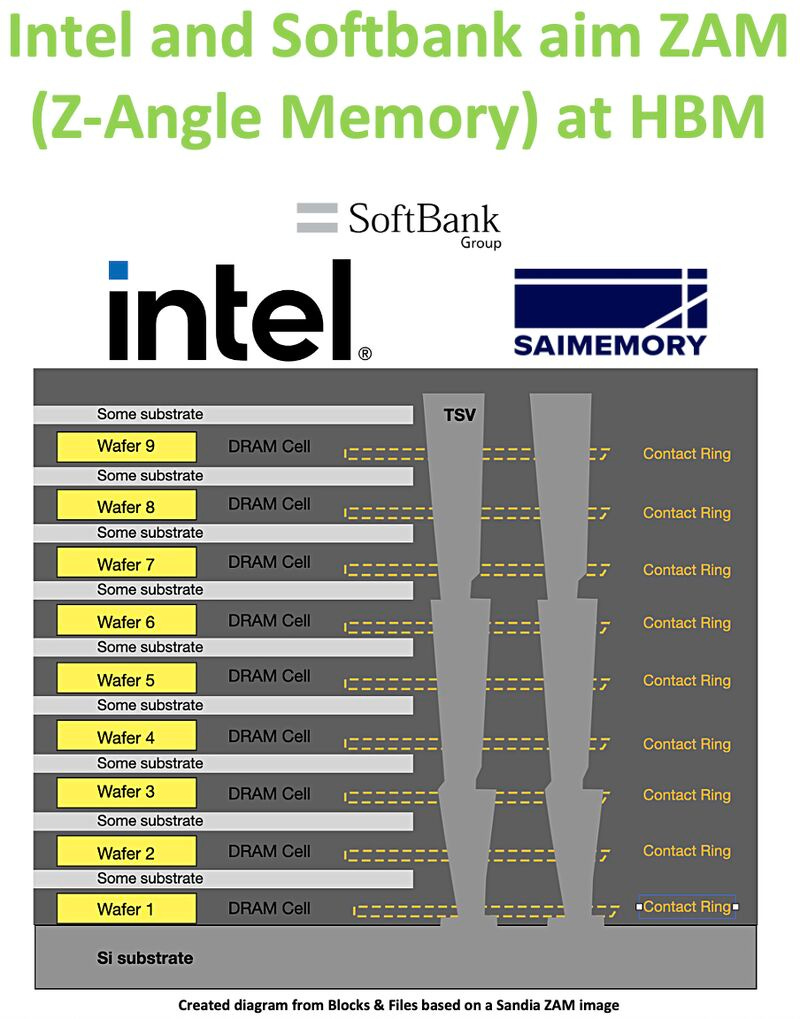
Now, some of you might know that Intel plans on commercializing this via a SoftBank partnership through Saimemory. The details are still a little fuzzy, but it appears that Saimemory and Powerchip (which has a 20nm DRAM process) were going to somehow get a more advanced process and then manufacture it. For example, the three memory players are on a 10nm process, using the Greek alphabet to denote new versions (I really don’t know memory, sorry).
Now, to clear something up: Logic is much harder than memory in terms of difficulty to manufacture. Both TSMC and Intel, if they wanted to, could go out and spend a lot of money, take some years, and have a decent DRAM process. The opposite is true of Hynix and Micron. However, both TSMC and Intel would not have competitive costs due to the scale of Hynix, Samsung, and Micron, and in any down cycle, you would just be burning money. Historically, this is why TSMC and Intel famously got out of DRAM. But this hasn’t stopped either and more specifically, Intel from dipping its toes into the NAND and DRAMish side of the business. Intel had a NAND business, which it sold to Hynix, and Intel also had Optane, a novel memory technology, before it shuttered it. Intel, with some of Powerchip’s IP and Elon Co funding, could develop a DRAM process in time and then use its ZAM packaging, and now TeraFab could have memory made on-site as well.
Is this the likely option? Probably not, that’s simply Micron building a fab on-site. But it’s Elon, and he’s got a lot of money, and Intel has an interesting technology that could be ready in 2030.
Design Help
There was a small hint in the announcement, but Intel mentioned design help as well. For those who don’t know, or don't bother to do a little research… Tesla uses GUC for IP and design help on its AI series of chips. Tesla has had issues in the past few quarters on AI5 and AI6, and Intel, with its ASIC design business, is likely to fill in for GUC and also provide more on-the-ground support. This is bullish for Intel's ASIC design business and will help them get their sea legs. I also have a weird feeling that Intel asked that Tesla use Intel x86 CPUs for its space datacenters and maybe its robots. I just have a feeling, let’s see.
What Intel investors should think about this deal
We don’t know the full details. It could end up being more like a rent-a-fab by Elon, which is more favorable to Intel, or more like IBM to Rapidus, which is less favorable to Intel. My scenario and belief is more middle-of-the-road.
As long as Intel strongly protects its IP, meaning they never let Tesla fork the process and ditch them later, and ensures TeraFab is limited to Tesla’s own internal products, I am okay with this setup. A pseudo licensing and partnership deal delivers royalties and fees to Intel while they chase down TSMC and the broader foundry market is a good deal.
There is plenty of TAM and money to be made just beating TSMC as America’s Foundry. Intel can win its core IDM business for CPUs, GPUs, and networking, as well as an ASIC design partner for hyperscalers. All of this comes with an upside bet on Elon being Elon, driving large volumes based on Intel’s process nodes, Intel packaging, and possibly Intel memory made right here in the USA.
Great analysis as usual, Alex.
Nice read mate, I also hope something with memory kick-starts. Elon would love to save costs by cutting out another external, and Naga is at the helm, after all ;)