Intel's Foundry Solution: Sell to China, Reinvest in America
Let's make China's demand for chips pay for the future of American Semiconductor Manufacturing. Our export controls are contradictory and fail to achieve our end goals.

Background
I believe that strong and universally applied U.S. export controls on China are the right approach to help the United States lead and be the first to achieve 'AGI'. However, the current technology export controls are ineffective and rife with contradictions and hypocrisy.
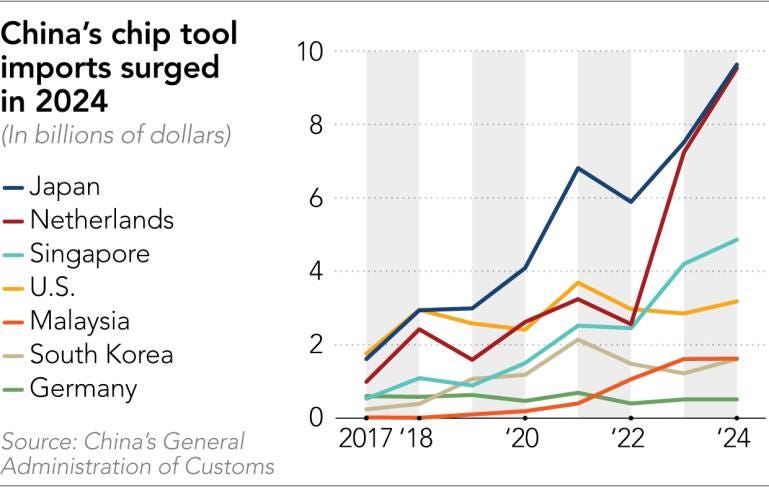
Currently, the U.S. allows some American semiconductor equipment to be sold to entities that serve as obvious backdoors to SMIC and Huawei, both of which are on the U.S. Entity List. Simultaneously, these restrictions are not placed on U.S. allies such as Japan and the Netherlands. This effectively allows SMIC and others to produce 7nm and smaller chips using increasingly costly and complex processes, which is a viable strategy for China as it heavily subsidizes the industry.
Furthermore, the U.S. permits the sale of Nvidia's H20 and potentially the upcoming B30 GPUs to China, taking a 15% cut of the revenue. This policy means China can simply connect a sufficient number of these GPUs, powered by its massive energy surplus, to build models that rival those in the U.S., as demonstrated by the DeepSeek model earlier this year. The combination of these GPUs with domestic fab’s from SMIC and Huawei allows China to mass-produce its own GPUs and ASICs for training and inferencing large language models.
For more information on how current U.S. export controls are failing to stop China, I recommend reading the recent piece on this topic by SemiAnalysis:
https://semianalysis.com/2025/09/08/huawei-ascend-production-ramp/

The Current State of Export Controls for the Foundry Industry
Under current rules, TSMC and other foundries are not allowed to produce chips of any process node for companies on the U.S. Entity List, such as Huawei and Cambricon. However, Chinese companies not on the entities list like Alibaba, Baidu, Tencent, and Xiaomi—are permitted to have non-AI chips produced at TSMC, including automotive components and, in Xiaomi's case, a phone SoC.
The current export controls, with the exception of restrictions on EUV tools, are allowing Chinese foundries to slowly advance Moore's Law. This progress will likely continue until Chinese equipment manufacturers eventually succeed in creating domestic alternatives. The question isn't if China will effectively replace companies like Lam Research, Applied Materials, and Tokyo Electron, but when. Given the immense resources China is dedicating to this effort, it will also eventually develop domestic EUV technology. China already dominates the solar and EV industries; with its large talent base of engineers and vast state resources, it will figure out advanced semiconductor capital equipment as well. This situation creates a window for U.S. players to sell into China and profit, but that window will eventually close, much like we are seeing in the automotive industry.
So, what aren't we doing? We are not creating a strong domestic foundry that would allow the U.S. to operate independently across the entire AI stack. Fabless competitors like Nvidia and AMD, along with semiconductor equipment companies, are permitted to sell their products to China. Yet Intel is specifically barred from selling its foundry services, including its advanced 18A wafers, to Chinese firms.
Why Intel should be allowed to sell 18A to China
Intel has a severe lack of customers for its foundry services. However, it is utilizing its own internal manufacturing capacity for its products, such as the upcoming Panther Lake CPU for laptops, which is expected to ship in the tens of millions of units next year.
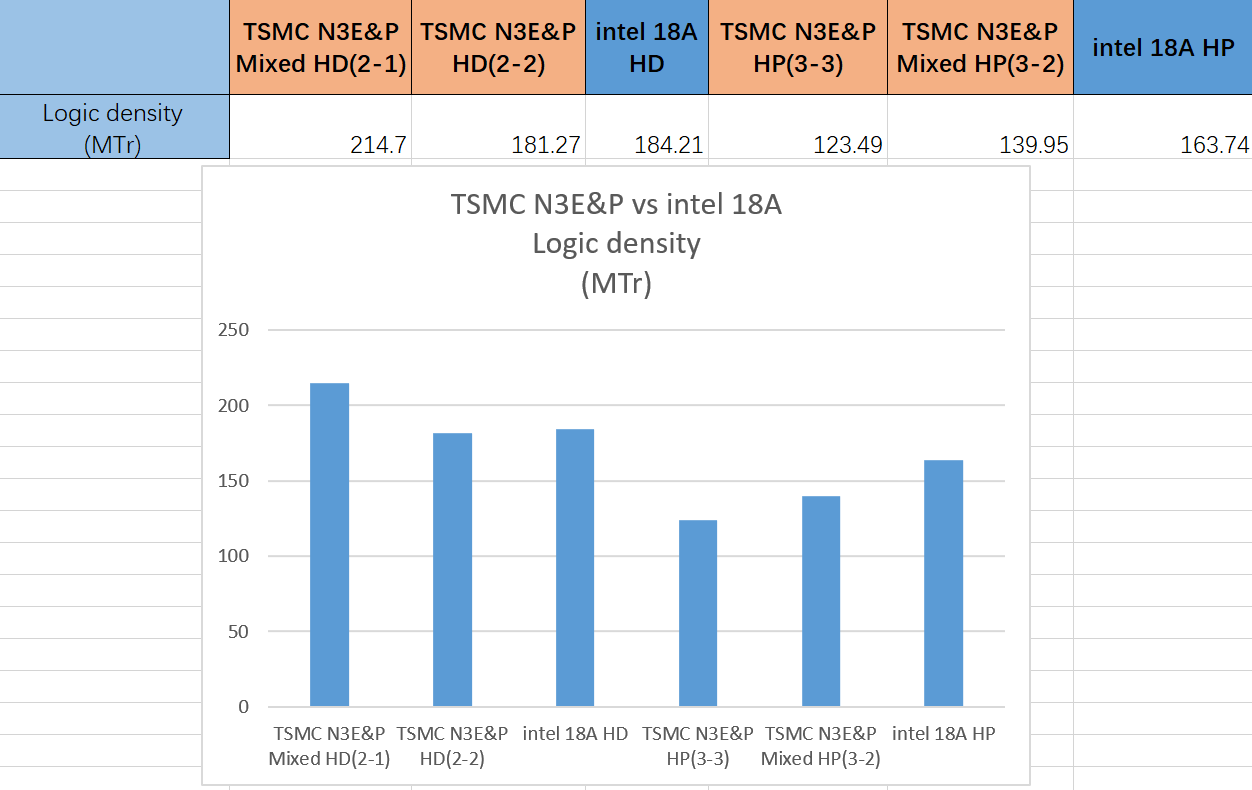
Meanwhile, major U.S. players, including Qualcomm, have stated that Intel's 18A process is not suitable for their mobile handset needs. The 18A node was primarily designed for HPC products to meet Intel's own requirements, with its PPA metrics falling somewhere between TSMC's N3 and N2 nodes.
(Density isn’t everything, but 18A has prioritized the HP cell)
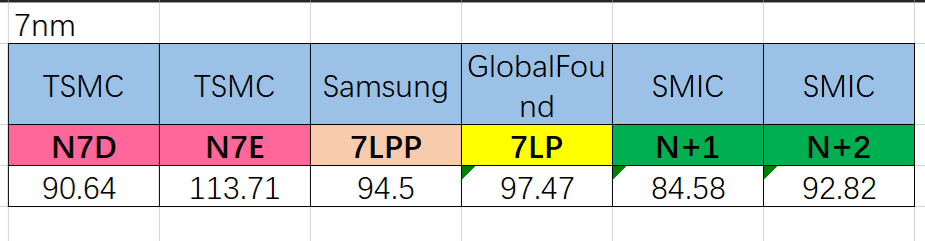
Chinese design houses are currently limited to SMIC's 7nm process, which has poorer yields than the industry average due to the limitations of its current tooling and methods, such as SAQP (Self-Aligned Quadruple Patterning). Their upcoming 5nm node will likely suffer from even worse yields because it requires even more complex multi-patterning.
(Intel 7nm class node is around ~100 MTr/mm²)
Chinese design firms such as Alibaba, Baidu, and Tencent would love to design their own ASICs on a leading-edge, HPC-focused node. Moving from SMIC's 7nm process to a node equivalent to ~2.5nm would be a major uplift for them. These companies were previously allowed to use TSMC and have been keen to develop custom alternatives that suit their unique cloud and AI needs.
Intel's internal pricing for 18A wafers likely falls somewhere around $23,000 per wafer. Chinese firms, however, would gladly pay a premium for exclusive access to a leading-edge node, and it is not unreasonable to think Intel could fetch more than $30,000 per wafer from them. This would provide a massive gross margin boost for Intel and generate cash flow to reinvest in catching up to TSMC. Given the fierce competition from TSMC for U.S. customers, Intel could likely achieve significantly higher gross margins by selling to China. These Chinese firms would also be more willing to overlook Intel's learning curve in the foundry business, an advantage Intel lacks with it’s American clients.
By allowing Chinese firms to use America's foundry, they would effectively be financing the expansion of the U.S. semiconductor manufacturing industry. This arrangement would provide Intel with crucial production experience, enhancing its yields and technology. More fabs could be built in the U.S., more workers could be hired, a large American export market would be created, and Intel could increase its R&D spending to get to parity with TSMC. U.S. firms would be spared the feared cost of helping Intel catch up, a concern that, according to The New York Times, executives at fabless companies are already discussing.
Benefit of the bargin
One might ask themselves, "But doesn’t this undercut the ‘American Stack’?"
Let's weigh the pros and cons of the current export controls and what the country gets from them. Nvidia’s net income last year was $80 billion, and that's projected to increase to well over $100 billion. The benefit to Nvidia is obviously higher revenue and more profit. The company spent $25 billion on share buybacks in the first six months of this year, which is fine. A company’s primary obligation is to its shareholders, and more profit for investors benefits all Americans who have a retirement account. But selling to China involves national security concerns. If we are going to undertake an action that helps an adversary, shouldn’t we get something more substantive out of it?
You might argue that we want to get China "addicted" to the "American stack." However, a software moat is something China can overcome. They have already developed their own internet stack and cloud companies. They have over 50% of the world's AI developers and a massive pool of talented engineers. If Google, on its own, can train models like Gemini and Veo using its own proprietary software stack for TPUs, do we really think that the entirety of China won't be able to create a well-written software stack for training and inference? That seems like a preposterous proposition.
A real, defensible moat, is clearly in the foundry business. There are only three global players at the leading edge, with SMIC aspiring to be the fourth. Both Samsung and Intel have struggled, while TSMC operates a near-monopoly. Clearly, being a manufacturer of chips is a larger moat than designing them.
The benefit of the bargain the U.S. gets as a country by allowing Chinese design firms to use Intel is very clear. A successful Intel means domestic R&D for process nodes and tens of billions in capital expenditures to build fabs in America. This ensures that if something happens to Taiwan, we have a backup for both R&D and manufacturing capacity. This point is lost on many people. Process node R&D is a prerequisite for any independent domestic production; without it, even TSMC's U.S. sites would stagnate if cut off from Taiwan. For context, TSMC has stated that its six-fab complex in Arizona, complete with packaging and an R&D center, will employ 6,000 Americans when it is completed in the 2030s. In comparison, Intel's R&D center in Oregon alone employs more than 18,000 people today.
There are massive upsides for the U.S. in having a thriving domestic semiconductor manufacturing industry—for workers, academia, American innovation, and national security. With Intel being the only U.S. company left on the leading edge, ensuring its survival is paramount.
Intel should strike a deal with the government to provide its 18A and upcoming 14A nodes to Chinese designers. China has more than enough demand to absorb all of Intel's current spare capacity, which would put Intel Foundry well into profitability. These profits could then be funneled into creating more domestic capacity, increasing Intel's capabilities and technology. Any licensing deal should be structured to enforce this reinvestment.
Let us use the leverage we have created with export controls to build our domestic industry, not merely to increase the profits of already extremely profitable firms. If we are going to sell to China, which is the current U.S. policy, we should not be benefiting foreign semiconductor equipment firms over domestic ones.
We are currently helping very profitable design firms, all of which rely on a single source, TSMC, which has committed to producing 70% of its leading-edge wafers in Taiwan and whose R&D complex will remain in Hsinchu, Taiwan.
Let American industry get the benefit of this bargain, with the U.S. taxpayer now along for the ride.