Should Intel enter the memory business again?
Intel invented DRAM and exited in 1985. They invented Flash and sold it in 2020. This time, Intel has something new: ZAM

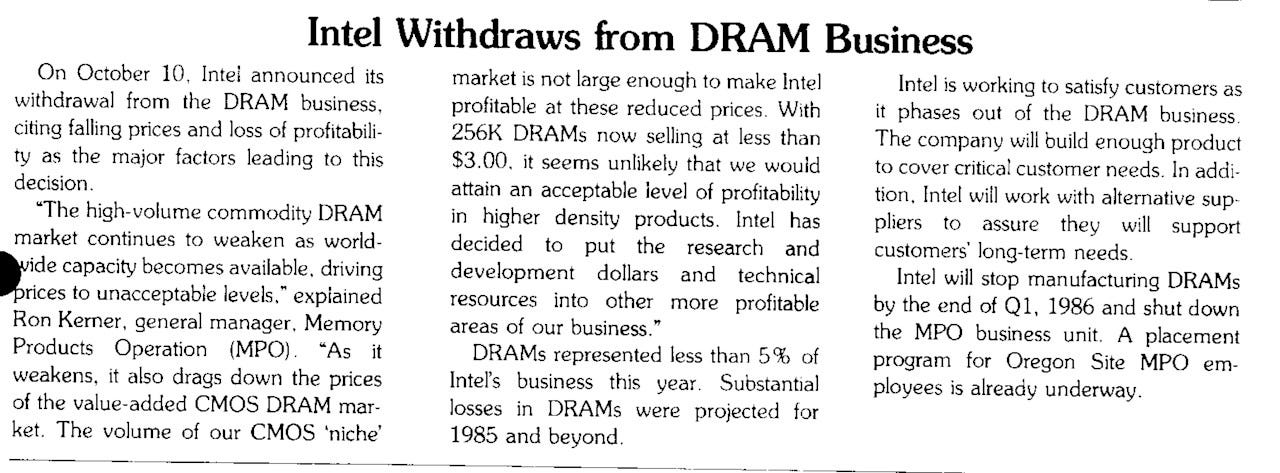
Let’s start with a brief history: Intel began as a DRAM company. They practically invented and popularized the technology, making a killing in the ‘70s. However, as Japanese manufacturers ramped up supply in the 1980s, the market became brutal. Intel almost went bankrupt; luckily, IBM took a stake and provided a lifeline.
They began to pivot to microprocessors. In one of the best and most famous business decisions of all time, Intel abandoned DRAM entirely and stole the show with the i386 (and x86 has dominated ever since).
Throughout Intel’s history, the company has always found useful things for transistors to do. One of those ventures was flash memory. Intel sold its NAND business to SK Hynix in 2020, along with the IP, patents, Chinese manufacturing employees, and US sales and operations staff. People now look back at this as a mistake.
Arguably, holding onto it would have drained R&D money and talent, not to mention the immense political risk of keeping a fab in China. It was the right move in 2020, given what Intel had to do just to survive as a leading-edge logic player. Intel did, however, keep its Optane IP and patents.
Just to close the loop on this: Intel did most of its NAND R&D in Oregon, and that knowledge was not lost to SK Hynix. They still have plenty of employees with the expertise. However, let’s be honest here. Hynix would probably not be thrilled to see Intel try to reverse engineer its way back into NAND, and that is a crucial business relationship. I am also not a huge long-term believer that NAND can escape its cyclicality or that Intel could offer a differentiated solution. Intel should not try to reenter the NAND business.
Now, when it comes to restarting Optane, Intel would need to see customers with specific AI workloads that would benefit from the uniqueness of the technology. Meaning, customers would need to come to them and place long-term order contracts. I view this as unlikely given the cost of Optane. So far, AI probably does not benefit enough (though I could be wrong!) from low-latency random IOPs.
The Real Question: Should Intel Enter the DRAM Business?
I am going to give the general pros, the cons, and my view on the differentiating factors that make this opportunity unique. Let's start with the cons.
Cons
DRAM will likely become cyclical again. Our current cycle is going to be longer and bigger than most think, but at some point, supply will overcome demand. Intel would likely have a higher cost structure than competitors like Hynix, Samsung, and Micron, making any down cycle significantly more painful.
Intel lacks IP and patents for DRAM. Our most recent example of a new entrant is China’s CXMT, which scraped its IP from the corpses of Innotron and Qimonda. I am no lawyer, but Intel would probably need (though I could be wrong) significant patent coverage just to operate safely. This means Intel currently lacks a concrete starting point.
Intel would be diverting critical resources from its logic business. The company has only recently gotten on stable ground and begun attracting large volume orders for its Foundry business. With the logic, TAM is likely to exceed $200B in the near future. Why risk their strengthening position to chase DRAM?
Pros
The DRAM market is growing. While cycles will still happen, the TAM is going to be massive and the downturns less severe than before. If the average margin stays above 40%, it is a highly attractive business for Intel to enter.
Intel risks DRAM supply becoming a constraining factor for its logic business in the coming years. Samsung could easily use its DRAM supply as a weapon, leveraging it to steal customers away to its inferior nodes when those customers might have otherwise preferred Intel. Intel must secure dedicated production to offer customers an all-in-one solution. Being a leading Foundry in the era of exponential AI growth means offering everything.
Unlike its foundry competitor TSMC, Intel has deep knowledge of memory and DRAM. Most of the staff who worked on NAND and Optane still work at Intel in Oregon and New Mexico. Intel also benefits from Micron doing leading-edge R&D right here in the US. Taiwan simply does not have a pool of talent that has done leading-edge R&D in memory. In fact, Intel’s head of Foundry and R&D was the lead R&D executive at Micron.
The US government has a massive vested interest in Intel and is undoubtedly annoyed by the strong duopoly in Korea. Having two US players would strengthen US market share, especially since Intel’s foundry business provides non-cyclical revenue to help weather the storms. There are some patent issues with this, which I am going to get to later.
My view
Intel should enter the DRAM business under certain conditions, which I am going to lay out. The primary reasons to enter are the following:
Intel’s ZAM packaging technique is a unique differentiator compared to HBM. It can command higher pricing and holds scarcity value due to its patent protection.
Elon wants TeraFab to produce memory, and so far, Micron, Samsung, and Hynix have refused to license their IP.
Hyperscalers are annoyed by the current pricing dynamics. It’s highly likely they would desire a fourth producer, specifically one where they can take a stake in production and ownership to help control costs.
Intel’s recent stock performance presents the opportunity to use that equity value to acquire the missing IP and patents.
Let’s dive deeper into each point.
ZAM
Intel's primary reason for getting back into the memory business would be to produce the DRAM wafers for ZAM.


To make a long story short, Intel worked with the DOE to speed up nuclear bomb physics research as part of a government program aimed at achieving higher memory bandwidth technologies. During this project, Intel developed a unique method for making TSVs, as well as stacking and cooling DRAM stacks, which achieves higher bandwidth, greater density, and lower power usage compared to HBM.
When it came time for commercialization, Intel teamed up with Softbank to create Saimemory, which then partnered with legacy DRAM manufacturer PSMC for the wafers. PSMC only produces 20nm DRAM-class wafers, yet ZAM achieved a similar bandwidth to the upcoming HBM4E. That is... amazing. The density is pretty crappy compared to HBM, but keep in mind HBM competitors are using 1c 6th gen 10nm nodes!
Questions remain on its manufacturability. That is the linchpin, no doubt.
Elon and TeraFab
The reason Intel might shift from just collecting license revenue on Saimemory ZAM to actually manufacturing DRAM and packaging ZAM is simple: Elon wants to make DRAM in-house.
This represents a unique opportunity for Intel to leverage a partner with deep pockets who is actively staffing up on R&D talent. It means Intel does not have to fully turn its Oregon operations into Boise 2.0. You can easily imagine Intel providing its know-how, processes, and early research for a joint R&D endeavor. Meanwhile, Tesla spends the big bucks on the necessary R&D tooling and aggressively poaches talent from Korean firms and Micron to accelerate the process.
I envision a scenario where Tesla and Intel hold a joint license over the DRAM process node. This would allow Tesla to freely produce memory for itself, while giving Intel the right to manufacture it in their own fabs as well.
Hyperscalers
Hyperscalers are certainly becoming more AGI-pilled, and they have come to the realization that DRAM will be scarce for the foreseeable future. If you believe in the Dario exponential curve, this DRAM cycle is going to last for a long time. They have to be incredibly annoyed at the prospect of ever-increasing, non-fixed price agreements with current memory manufacturers. Hyperscaler CAPEX is inflating entirely from memory prices at this point, and the big three memory players are looking at gross margins in the 70% plus range for the next several years.
Therefore, to bring costs under control, it is in the best interest of the hyperscalers to introduce a fourth player into the market, one in which they have a stake, allowing them to control costs at a fixed level. As Intel and Tesla develop their DRAM process, it is easy to imagine hyperscalers wanting to fund these DRAM fabs in exchange for fixed gross margins. Intel would gladly take that deal. This is a bonus business on top of their logic operations and would drive significantly higher returns.
IP & Patents
So this all sounds great, right? Intel uses its ZAM IP, leverages partners, earns a decent (not 60% to 70%) gross margin return, and helps reinforce its foundry business.
But how do they actually start without all those pesky patents?
I see two obvious paths. There are likely more, but I am not going to waste days doing a deep dive on who exactly owns the most relevant DRAM patent portfolios applicable for licensing. The two obvious paths are
Buy PSMC
Acquire patents from WiLan (aka pull a CXMT)
Buy PSMC
This one is pretty simple. PSMC owns its own IP for the 20nm generation, and they have fabs and staff in Taiwan who could help jumpstart the initiative. They are already a ZAM partner, so they have a working relationship with Intel. Another interesting factoid is that Walden International (Lip-Bu Tan) helped them go public, meaning he has a long-standing relationship with the company.
PSMC’s current market cap is $7.5B. That is chump change now, given Intel’s stock valuation. Intel can issue shares and buy the company with cash, or do an all-stock deal.
There are two issues with this. One is that Taiwan might not allow the sale. However, Intel has the US government as a shareholder, so they can probably twist some arms.
The second issue is that to get beyond 20nm, PSMC has recently acquired a 1y license (2nd gen 10nm class) agreement with Micron. That would obviously be very helpful for Intel, but what strings are attached to it? Can Micron cancel it? I would be surprised if Micron allowed Intel to just jump in and start iterating on that node.
This is where the US government would have to step in and help Intel, essentially forcing or signaling to Micron that a second US player is desired. I do not know if that would actually happen. Intel might be forced to start off with just the 20nm patents and then organically develop a near leading-edge node from there.
Follow CXMT playbook
The other strategy would be to get (or buy) licenses from the Infineon Technologies spinoff, WiLan, which is the key patent holder for CXMT. I am not sure if CXMT has exclusivity, but whatever WiLan still holds could prove highly useful. Ultimately, Intel likely needs something to serve as a foundation. Hell, maybe our new Trump Chinese detente allows Intel to get a direct CXMT license! (lol)
Summary
Ultimately, I think Intel entering the DRAM business would be a great initiative, but only if they can attract the right partners. Intel is not going to achieve a similar scale to the Big 3 anytime soon, so it needs end customers to step up to partner, fund, and guarantee they will buy the output at costs that are attractive to players like Google, Microsoft, Amazon, Apple, Anthropic, and OpenAI (probably 40s range gross margin for Intel).
Intel can then use its ZAM packaging to command a higher gross margin for accelerator products, since it is truly differentiated compared to regular DRAM or even HBM (Intel will likely produce both commodity and ZAM).
Elon is the X factor in all of this. Since he would be the early R&D funder and JV partner for the license. I imagine the rest of the hyperscalers will only jump in after the tech is near HVM-ready.
If these partnerships don’t materialize or decline to participate. Intel should not enter the DRAM business and be content with potential license revenue from Saimemory when they reach agreements with Hynix, Samsung, and Micron.
Nice article. Until foundry is up and running, prefer Intel not focus on major tasks
Great summary Alex