The Intel-Nvidia Alliance: A Sub Rosa Affair
Intel and Nvidia's product tie-ins make a lot of sense. But why the need to take a $5B stake? The actual behind-the-scenes reasoning

There are two key parts to this deal: one has been ongoing since last year, driven by mutual interest, and the other is coming from the top down.
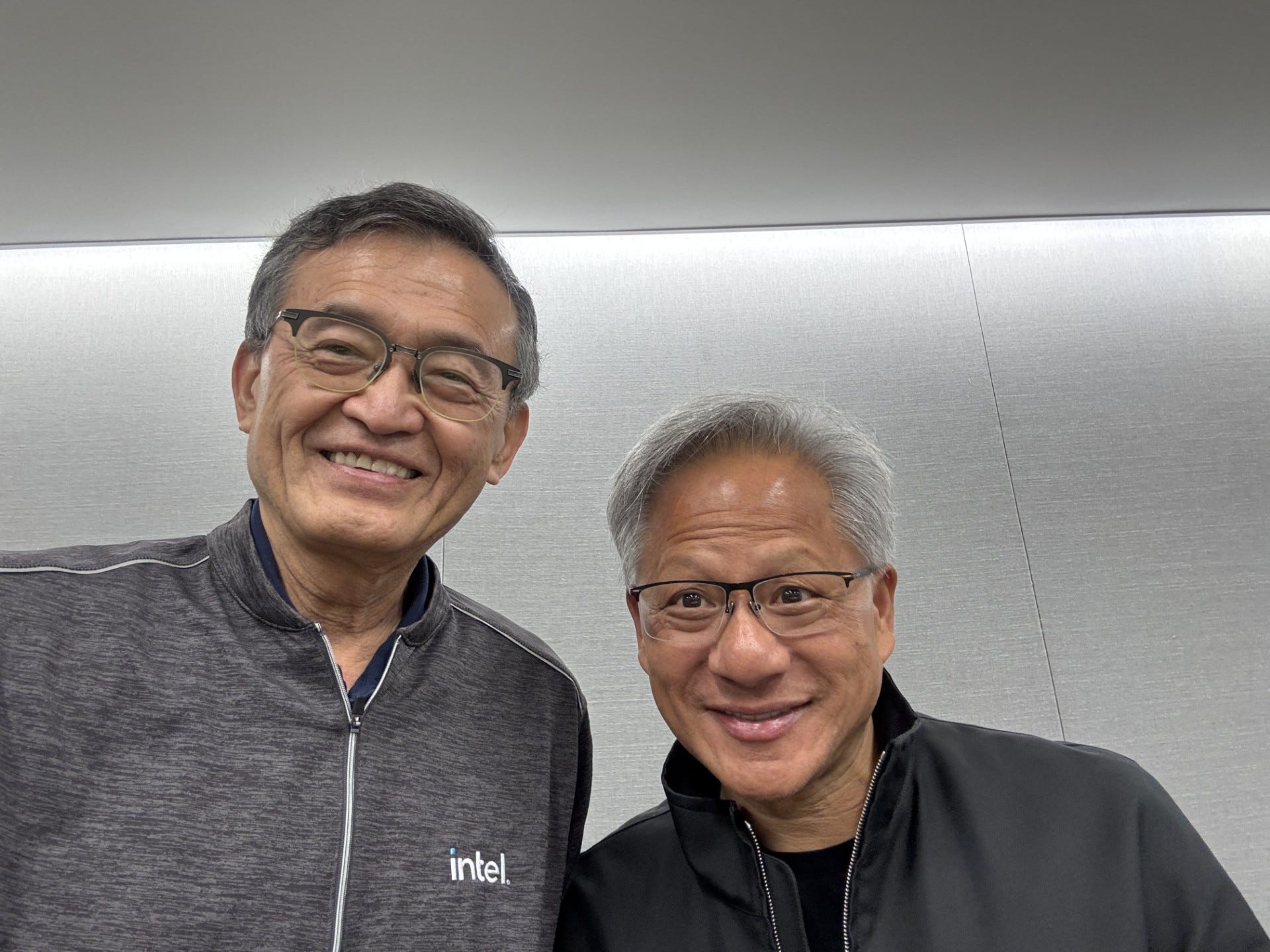
On the surface, the big announcement was the product side partnership; both CEOs desperately tried to keep on message but largely failed. There's a lot to discuss there, but I'll save the dry analysis at the end of the article. The markets move today has not priced Intel Foundry success, not even close. The more interesting moves were among the equipment makers, as people buying those stocks clearly got the message many “Analysts” remain puzzled on. There is a deal under the table. Lip-Bu was kind enough to give us a hint: “Jensen and I will review that [14A PDK],” and the Trump administration will make it happen.
The only thing that actually matters in today's announcement was Nvidia’s $5 billion stake. Even without the juicy behind-the-scenes tidbits from The Wall Street Journal and The New York Times, basic logos would lead you to the conclusion that this came from Trump.
Intel's CFO stated that they weren’t seeking any more stake sales a couple of weeks ago at a Goldman Sachs conference. Before this capital raise, Intel had $2 billion from SoftBank, $3.4 billion from the Altera Sale, $5.7 billion from the USG, and $1 billion from a Mobileye Sale. They also had $1 billion coming in 2026/2027 from the Altera Sale and $3.3 billion by 2028 from the USG Secure Enclave. This meant $16.4 billion was coming before they would need to start buying equipment in late 2027 for the 14A ramp. After this raise, they now have $21.4 billion in new capital before 2028. Intel still has $8 billion in Mobileye to sell if needed, and the NEX spinoff may raise a couple billion more.
If Intel lands a major customer next year and more in late 2026/2027, the stock would surge, and they could raise capital at a much higher valuation. Problem solved.
So why the raise? Jensen during the call gave one of the worst answers I’ve ever heard:
"We just thought it was just going to be such an incredible investment […] How could we be just so excited by the products and on the other hand not be excited by the opportunities ahead? So we are delighted to be shareholders of Intel. The return on the investment is going to be fantastic […] It just reflects how excited we are."
(I may have missed a word or two, but this is what he said.)
Really? Is Nvidia taking stakes in all its partners? They love TSMC, so why not use shareholder capital for that? Why not buy shares in Tower? Why not SK Hynix? Is Nvidia going to become a hedge fund with its shareholder capital?
The answer is of course not. The logical conclusion for why Nvidia is taking a stake in a company that is a rival to its almost exclusive manufacturer partner, TSMC, is obvious. Because the Trump administration wanted it, and Jensen wants to sell B30s into China.
David Sacks's post this morning is the first cue for the new lobbying effort ahead.
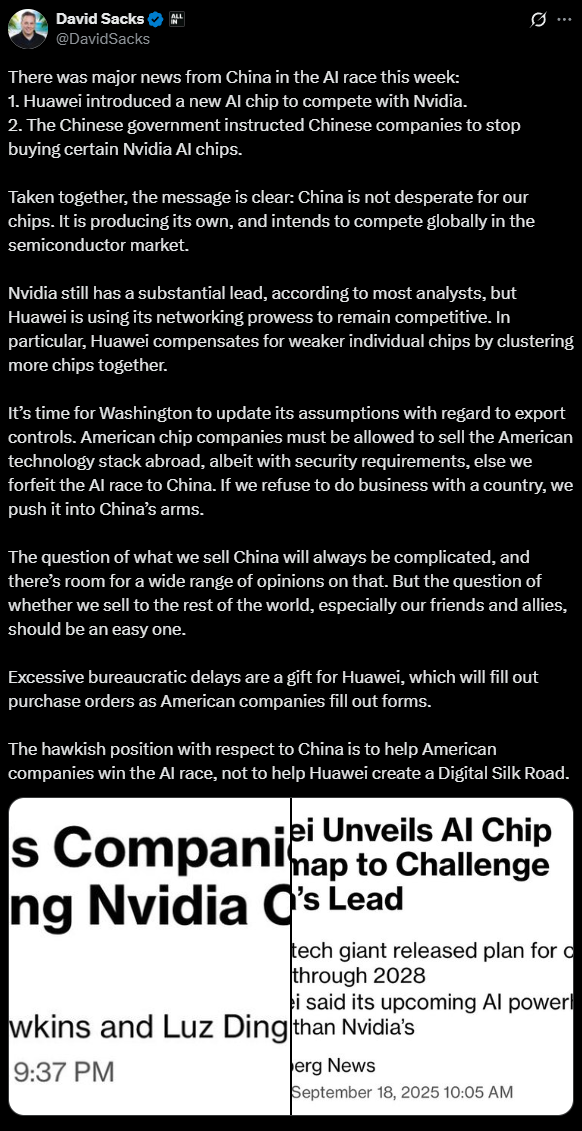
Some of the TSMC crowd (cough, Jukanlosreve ) thought this had no effect on TSMC because the deal didn’t publicly announce a foundry deal. Trump is a mob boss who always comes back for more, and Jensen bought some time with the stake. As the 14A PDK matures into 2026, a new "ask" will come for them and other companies. Now, beyond my speculation, we even have news outlets confirming this.
WSJ: “The Trump administration has committed to helping Intel find new customers to bolster the foundry business, according to people familiar with the matter.”
https://www.wsj.com/tech/ai/nvidia-intel-5-billion-investment-ad940533?mod=hp_lead_pos1
NY Times: “The Trump administration has stepped in to try to help Intel. In January, it approached Nvidia and asked it to invest in Intel, said two people with knowledge of the conversations, who were not authorized to speak about private discussions.”
https://www.nytimes.com/2025/09/18/business/nvidia-intel-stake.html
How is the Trump administration going to deliver on this promise? Clearly, through the leverage the Commerce Department has over tech companies via tariffs, export controls, and the bully pulpit.
Lip-Bu Tan is operating in sync with the Trump administration, which has a desire to bring back semiconductor manufacturing to the US rapidly. As I’ve discussed in prior articles, TSMC's pledge is a drop in the bucket compared to what the administration wants: 10M WSPY. To get there, Intel will be its vehicle due to TSMC’s political reality at home.
The Trump administration wants the Ohio project to be reaccelerated and its investment in Intel to look good. Intel's capital raise from Nvidia is what they wanted back in the beginning of the year, and having both the world's biggest government and the world's biggest corporation as your capital partners certainly sends a message.
With this influx of capital, Intel has little reason not to speedup Ohio for the 2028 14A HVM. Will there be more capital raises? I don’t think so unless it's tied to a foundry deal. Based on current Synopsys headlines and the language coming from management, external 18A is somewhat dead, with Intel wanting to ramp Panther Lake in Q1 as a proof point to show customers and the government that they are ‘back’. I still expect second-wave 18AP deals next year as part of SoC chips that utilize both 14A and 18AP, with a lower likelihood of exclusively 18AP deals themselves due to the tapeout window closing by the end of the first half of 2026 (for the 2027 product cycle).
The next catalysts for the stock, barring some out-of-the-blue foundry announcement or a capital raise by Apple, are the semiconductor tariffs and the Japanese Fund.
The semiconductor tariffs have been delayed, and delayed again, for months. We had an interesting headline where Trump mused that since companies that make chips have higher profit margins, their tariffs could be higher than the 25% auto tariff. But there has not been much else.
I still believe that they are coming and will come in the form of a deadline to file with the Commerce Department (read my first article, seriously most people have missed this key piece of information 2:50)
I expect at this point that companies will have until sometime in Q2 of next year to get a plan approved before tariffs hit. This lines up neatly with Intel's 14A PDK, so companies with poor reshoring plans (aka all of them, due to TSMC's US capacity roadmap) will have their plans denied. Then, they will have to negotiate with the administration, and somehow, they will neatly end up needing to place orders with Intel for their plans to be approved. Its much harder to resist when government can point to 18A’s succesful ramp and 14A PDK quality being good.
The second catalyst is in the form of the Japanese fund. Since my first post, we have learned more details about how the fund works due to a joint statement.
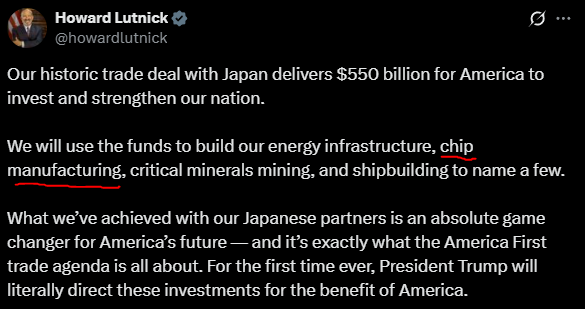
The fund is approved to support semiconductor manufacturing. When Trump approves a plan, it will go to a finance committee with Japanese and American members. Proposals must meet some basic requirements (they all will; let's be honest, the committee is sort of fake). A capital call will then go to Japan to wire the funds to a joint organization handling the project. If Japan doesn’t meet the capital call or the Japanese members on the committee don’t approve, Trump will just threaten massive tariffs since it would be an embarrassment to him (which is why all plans will get funded and approved).
Lutnick described that the joint corporation will build the infrastructure and then lease it to an operator. Well… that sounds exactly like what I said in my first post. IMO, Intel and the Commerce Department will reach an agreement on a ‘Shell Leaseback’ plan for the remaining three fabs in Ohio sometime next year while negotiations are ongoing around tariffs and the 14A PDK is being evaluated.
Will the market price this in ahead of time? Probably not, just like they missed this move after the government stake. We will have to wait for media articles to leak.
Next year, we will see a raft of companies signing onto 14A which will have Ohio Fab 27, possibly Israel Fab 38 and maybe Arizona Fab 62 depending on 18AP demand. The new capacity being created by the government will likely support the 10A node, with sign-ons happening in 2028.
Now back to product annoucements
On the data center side, this agreement is effectively Intel selling a custom x86 CPU that works with their NVLink scale-up architecture. This is good for Intel, since the AI headnode revenue on the HGX 8-way scale-up was going to start to fall off significantly in Rubin (it's already starting with Blackwell). I had become somewhat worried that as NVL72 share increased, Intel was going to start to lose volume and share in data center, which would really help ARM. Now, that's not going to happen as quickly or grind to a halt.
So why does Nvidia do this? Clearly, one has to survey the landscape. ARM CPUs work great for AI hyperscalers that have shifted internal workloads to ARM or have the resources to move their own stack. That is simply not the case for almost all enterprises and even some internal hyperscale workloads. These run on x86, and Nvidia was facing a rough sales pitch: "Hey, why don’t you rework your entire operating infrastructure to support ARM? Oh, and we can’t help you." Meanwhile, AMD, with an actual scale-up AI GPU rack next year, can slide in with these customers and require no changes except for learning ROCm, which has its own difficulties. This is not great for either party, but it's probably harder sale for Nvidia with enterprise customers new to AI. With the Intel partnership, Nvidia just shot down AMDs opening. Its number one priority is ensuring there is no second-source merchant GPU; they want no beachhead on Normandy.
On the PC side, IMO, Jensen was overselling this very hard, I really don’t see much here. Intel has zero interest in making every GPU on its SoCs an Nvidia one, nor do customers actually care. The vast majority of laptops and even desktops sold are just fine with a crappy to mid-range GPU tile to power PC applications. Nvidia is not filling this void.
What Nvidia is offering Intel depends on how far Intel takes the axe to Arc. Right now, Intel's Battlemage tile in Lunar Lake is quite good, maybe 30 mm^2 with 8 Xe2 cores, and it performs decently at light mobile gaming. I don’t believe Intel wants to replace that with an Nvidia GPU tile.
In my opinion, the Intel-Nvidia PC partnership is mainly targeting ‘Strix Halo’ products that are replacing discrete GPUs in laptops. Nvidia had no way into this growing market since WoA stinks (Qualcomm surely knows). Nvidia believes these products, which support gaming and AI, will become a larger part of the market. This is due to both new uses for AI on the edge and the fact that laptops with large APU’s are just superior for most use cases compared to discrete GPUs (maybe throw in desktops with large APUs, too).
Intel has almost no share here and likely feels Arc on the gaming side isn’t going to be competitive enough. Intel wants to take share back from AMD + Nvidia discrete laptops. With a new sexy Intel + Nvidia gaming APUs in laptops, handhelds, and maybe gaming consoles down the road (Microsoft?), these products will sell very well.
Please read my original article for context
Per aspera ad astra

Great post, Alex. For the raft of companies signing up for 14A next year - which companies do you expect to be next, and why would these commitments come so early in 2026?
I personally believe Elon and LBT will make an announcement before end of this year.
I’m curious to know your thoughts on the comments about packaging. Do you think it offers any significant benefits?